 Watch here
 Global Coalition On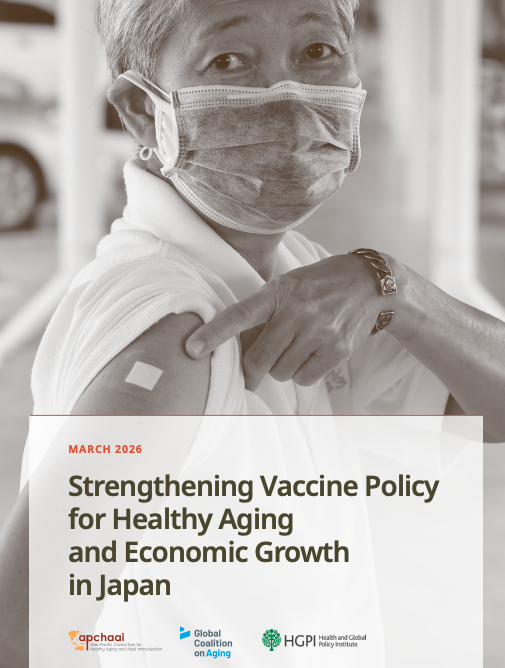
Findings suggest that revisions to immunization policies could strengthen productivity, equitable access, and the long-term health of Japan’s older adults
 Tokyo, JAPAN and New York, NEW YORK (March 5, 2026) -The Global Coalition on Aging (GCOA), Health and Global Policy Institute (HGPI), and the Asia-Pacific Consortium for Healthy Aging and Adult Immunization (AP-CHAAI) today announced the launch of Strengthening Vaccine Policy for Healthy Aging and Economic Growth in Japan, a landscape analysis examining the state of vaccine policy in super-aging Japan. Based on a comprehensive review of over 100 policy documents, recommendations, reports, academic papers, and gray literature articles, the report, which was funded by GSK, summarizes the latest academic research and policy discourse around adult vaccines. Its findings suggest that Japan is not realizing the full benefits of adult vaccines, with the current adult vaccine policy framework placing a disproportionate burden on fiscally constrained local governments and individuals, undermining equitable access. Among other recommendations, the report calls for Japanese decisionmakers to reexamine how diseases are categorized and included in the national immunization schedule.
“Japan’s current vaccine program leaves much of its implementation to local governments, and as a result, challenges around access are beginning to be discussed in some areas. As a super-aged society, the country needs to move toward proactive prevention, driven by stronger leadership, with a focus on promoting healthy longevity. HGPI believes it is important to address these challenges through constructive dialogue among all stakeholders.” explained Ryoji Noritake, Chair of the Tokyo-based Health and Global Policy Institute, one of the organizations behind the new report.
The report calls on leaders to (1) clarify conditions for inclusion in the routine immunization schedule and review the positioning of one or more Category B diseases under the Immunization Act; (2) unify national and local financing mechanisms to eliminate disparities in vaccination access across municipalities; and (3) strengthen preventive health policies to sustain Japan’s healthcare system and advance its silver economy through higher adult vaccination rates.
These proposed changes will support Japan’s global leadership on universal health coverage and health equity, strengthen the efficiency of the health system, and support continued growth. “In countries like Japan, where older adults represent an increasing share of the workforce, the effective use of preventive health tools like adult vaccines reduces avoidable healthcare spending and supports greater productivity, contributing to overall economic growth” said Michael Hodin, CEO of the Global Coalition on Aging and a global thought leader on aging-related policy.
To advance the dialogue on vaccine policy for Japan, GCOA and AP-CHAAI, in collaborationwith HGPI, will bring together global, regional, and local policymakers, experts, healthcare practitioners, and researchers, on March 11, for a private convening in Tokyo to discuss the role of adult vaccines in advancing healthy aging and economic growth both in Japan and throughout aging Asia.
—
For more information, please contact:
Susan Schwarz / Global Coalition on Aging
About the Health and Global Policy Institute
Health and Global Policy Institute (HGPI) is an independent non-profit, non-partisan think tank established in 2004. Since its establishment, HGPI has worked to organize extensive discussions with a wide range of stakeholders on the pressing health policy issues, and to offer policy options to society. HGPI is committed to the goal of promoting effective health policy choices for Japan and addressing today’s global health issues through cooperation with a wide range of stakeholders.
About the Asia-Pacific Consortium for Healthy Aging and Adult Immunization
The Asia-Pacific Consortium for Healthy Aging and Adult Immunization (AP-CHAAI) is a pioneering initiative dedicated to improving adult vaccine access and uptake across the Asia-Pacific region. By bringing together leading public and private sector experts, AP-CHAAI aims to break through the knowledge and policy barriers that hinder adult immunization, which pose a growing threat to healthy aging.