 Watch here
 Global Coalition On
 Report calls for international collaboration and greater funding to drive antibiotic innovation as top priorities for countries.
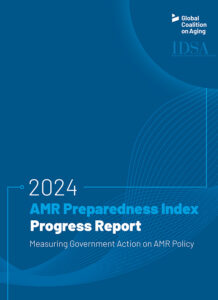 New York, NEW YORK (February 15, 2024) – Today, the Global Coalition on Aging (GCOA) and the Infectious Diseases Society of America (IDSA) launched the 2024 AMR Preparedness Index Progress Report. Released in the lead up to the United Nations General Assembly 2024 High-level Meeting on Antimicrobial Resistance (AMR) this September, the 2024 Progress Report assesses how the eleven largest global economies have advanced on calls to action laid out in the 2021 AMR Preparedness Index. The 2021 Index examined over 100 metrics to evaluate and rank countries’ performance against AMR and establish benchmarks for policy action and leadership.
Each year, nearly 5 million deaths are associated with AMR, with disproportionate impact on low-and middle-income countries. Without the creation of innovative and novel antimicrobials, growing resistance to our existing drugs threatens our ability to perform even routine medical care. AMR is a significant barrier to health system sustainability and public health, including healthy aging. It is also an economic challenge – without correcting course on AMR, the World Bank estimates that AMR could cost the global economy as much as $3.4 trillion USD annually by 2023.
The 2024 Progress Report assessed the same eleven countries as the 2021 Index: Brazil, Canada, China, France, Germany, India, Italy, Japan, South Korea, the United Kingdom (UK), and the United States (US). The UK maintained its position as the global leader in the fight against AMR, and many of the countries showed promising progress in many areas, but there is still greater action and targeted investment needed across all countries evaluated, particularly to revive the floundering pipeline of novel antibiotics.
“AMR is no longer just a public health threat – it is already here,” said Michael Hodin, CEO of GCOA. “It’s imperative that global leaders leverage their power – both separately and collaboratively – to commit and implement concrete actions in the face of growing drug resistance. Without such action, we risk losing antibiotics, and with them, our ability to enjoy the longevity that we do currently. We hope that HLM in September will provide a forum to spur action and enable much-needed collaboration between countries.”
Key Takeaways of the 2024 AMR Preparedness Index Progress Report:
- Many countries have updated or created new national strategies on AMR.
- The antimicrobial market and antimicrobial innovation continues to be a major challenge around the world.
- The COVID-19 pandemic stymied progress on antimicrobial stewardship in several countries.
- The state of antimicrobial access has seen very little change from 2021, with few new approvals and little difference in affordability metrics across countries.
- Environmental initiatives saw modest progress in many countries.
Across indicators, more needs to be done to put a firm halt to the spread of AMR, including the following points:
- Governments should invest further in national action plans, making bold investments in AMR countermeasures as a key element of health system resiliency.
- Governments should implement robust push and pull incentives to revitalize antibiotic innovation.
- Governments should make the availability of novel antimicrobials a national priority, ensuring access and affordability.
- Governments should invest further in infectious disease training for medical professionals and better incentivize specialization in infectious disease medicine.
- Governments should work to further strengthen and connect resistance and antimicrobial consumption surveillance systems, including by investing in diagnostics infrastructure.
- Governments should further support data collection on AMR in the environment.
These key actions and more are detailed in the comprehensive main text of the 2024 AMR Preparedness Index Progress Report. The urgency of these findings underscores the collective responsibility to address AMR promptly and effectively.
Featured during today’s launch of the Progress Report were:
- André Luiz de Abreu, Ministry of Health, Brazil
- Neil J. Clancy, AMR Committee, Infectious Diseases Society of America
- Dame Sally Davies, UK Special Envoy on AMR
- Michael W. Hodin, Global Coalition on Aging
- Andrew Jack, Financial Times
- Matt McEnany, GCOA
- Dani Peters, Canadian Antimicrobial Innovation Coalition, Canada
- Maria Jose Ruiz Alvarez, Italian National Institute of Health (ISS)
- John Rex, AMR Solutions
- Luka Srot, IFPMA
The development of the 2024 AMR Preparedness Index Progress Report was supported by the International Federation of Pharmaceutical Manufacturers and Associations (IFPMA).
For media inquiries, please contact:
Danny O’Keefe
[email protected]
(917) 565-3001
About the Global Coalition on Aging
The Global Coalition on Aging (GCOA) aims to reshape how global leaders approach and prepare for the 21st century’s profound shift in population aging. GCOA uniquely brings together global corporations across industry sectors with common strategic interests in aging populations, a comprehensive and systemic understanding of aging, and an optimistic view of its impact. Through research, public policy analysis, advocacy, and strategic communications, GCOA is advancing innovative solutions and working to ensure global aging is a path to health, productivity, and economic growth. For more information, visit www.globalcoalitiononaging.com.
About the Infectious Diseases Society of America:
IDSA is a leader on issues of importance to ID professionals, including education and training, policy and advocacy, setting guidelines for patient care, and developing resources for clinical practice. It remains at the forefront of global health issues such as COVID-19, antimicrobial resistance and HIV/AIDS. Housed within IDSA is the HIV Medicine Association, (HIVMA) which represents medical providers and researchers working on the front lines of HIV. More than 12,000 IDSA and HIVMA members work across the United States and in nearly 100 other countries on six different continents. For more information visit www.idsociety.org. Follow IDSA on Facebook and Twitter.