 Watch here
 Global Coalition On
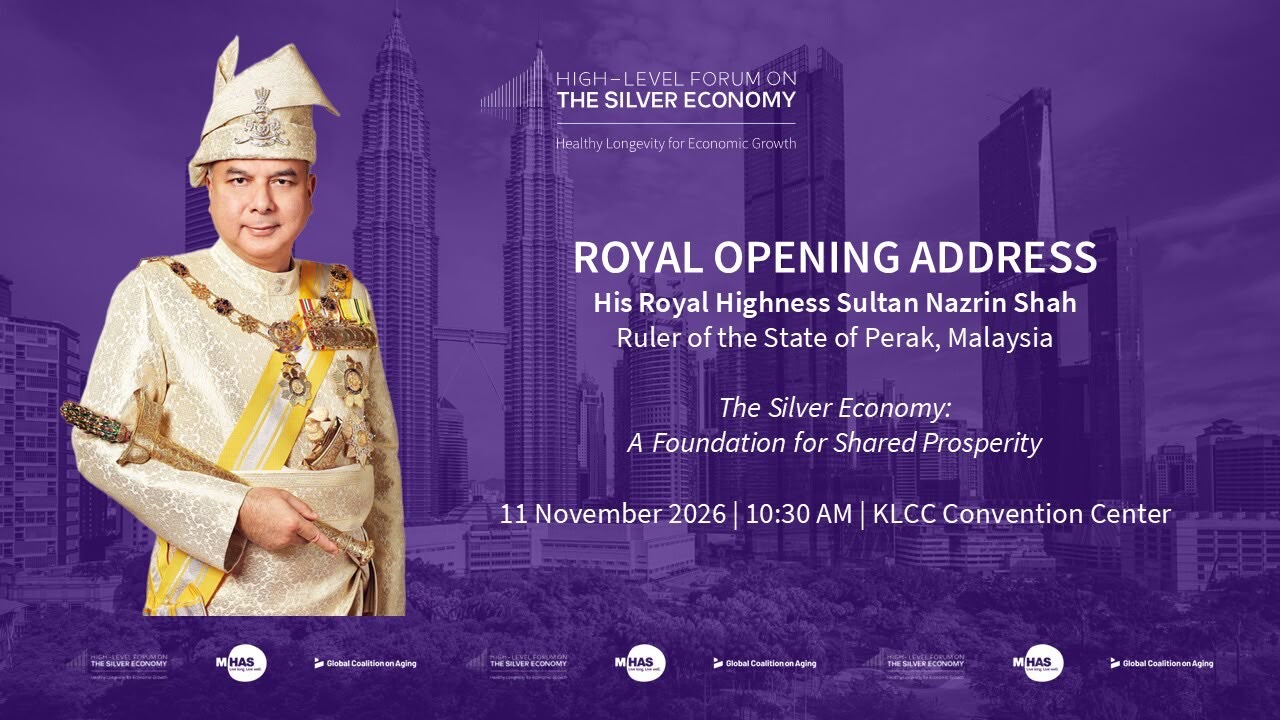
The Silver Economy: A Foundation for Shared Prosperity
11 NOVEMBER 2026 KUALA LUMPUR
It gives me great pleasure to welcome you to the Silver Economy Forum, convened for the first time here in Southeast Asia. I commend the Global Coalition on Ageing and the Malaysian Healthy Ageing Society for bringing this Forum to our region at a critical juncture, when the economic and social dynamics of shifting demographics require our undivided focus.
The Foundations and the Demographic Survey
Almost eleven years ago, in this very building, two floors below where we meet today, ASEAN leaders adopted the Kuala Lumpur Declaration on Ageing: Empowering Older Persons in ASEAN.¹
Returning to this venue allows us to measure our progress against the benchmark established over a decade ago. Under the same roof, we reaffirm a deeply held ambition: the creation of a society where healthy, active, and productive ageing is not an isolated luxury, but a communal reality.
Much has changed since then. Most significantly, the demographic future contemplated by that Declaration is rapidly becoming our demographic present. Across Southeast Asia, roughly one person in nine was aged sixty or above in 2020. By the middle of this century, that proportion will rise to one in five.²
While contemporary discourse frequently treats an ageing population as a fiscal liability or a strain on public infrastructure, we must remind ourselves that this transition is fundamentally a consequence of our success. The triumph of modern medicine, the expansion of public health, the improvement of nutrition, and the steady march of prosperity have granted millions of human beings the gift of time.
Lifespan and Healthspan: Assessing the Structural Deficit
Lifespans that previous generations could scarcely have imagined are now our shared reality. This truth was poignantly framed by the late United Nations Secretary-General, Kofi Annan. Speaking in Madrid at the Second World Assembly on Ageing, on a day that marked, with poetic resonance, his own sixty-fourth birthday, he reminded the global community: “We will all grow old one day – if we have that privilege, that is. Let us, therefore, not look at older persons as people separate from ourselves, but as our future selves.”³
To view our elders as our “future selves” is to fundamentally re-align our moral perspective. Longevity is not an external crisis threatening our social systems; it is our shared human inheritance, and a state of being to which most of us are subject.
We have become exceptionally proficient at adding years to our lifetimes. The question now is whether we can become equally proficient at ensuring those years are lived well. The empirical data indicates that we have a considerable distance yet to travel. Malaysia’s National Health and Morbidity Survey, published earlier this year, found that only 14.7 percent of Malaysians aged sixty and above met its criteria for ageing well.⁴
This figure, which represents the gap between lifespan and healthspan, should give us pause. It underscores the argument of Dr Atul Gawande, the surgeon and public health writer: “Our ultimate goal, after all, is not a good death but a good life to the very end”.⁵
This objective forces us to look beyond mere survival statistics and confront the core architecture of longevity.
Autonomy versus Covenant: The Philosophical Pillars
In his famous treatise De Senectute, the Roman statesman Cicero argued that old age is only respected if it vigorously defends itself, maintains its rights, and rules over its own domain until its final breath. The classical tradition thus grounds human dignity in a framework of self-reliance.
Yet, as we gather here in Asia, we must recognise the vulnerability hidden within that philosophy. By tethering dignity so closely to personal agency, it places a heavy burden upon the individual. It implies that respect is a prize to be defended rather than a grace naturally afforded by a civilised society. The unintended consequence of this view is that it leaves little room for severe frailty; it risks overlooking those who are no longer capable of asserting their rights or maintaining full agency over their lives.
The Islamic tradition takes a different view. The Prophet Muhammad, peace be upon him, established an enduring social covenant when he enjoined us, saying: “He is not one of us who does not show mercy to our young and respect to our elders.”⁶
Note the deep symmetry of this command. It spans the entire arc of human vulnerability, shielding the weakness of childhood with mercy and anchoring the frailty of age with honour.
The Obsolete Institutional Blueprint
Honouring that covenant today requires more than goodwill. It requires us to rethink how our societies are organised, much as an architect begins not with materials but with purpose: how a community will live, what its members will need, and how those needs will change across a lifetime. For decades, our institutions were built around a rigid, predictable life course: education, work, and a brief retirement. That blueprint is obsolete.
In Malaysia, around twelve per cent of the population are aged sixty or above.⁷ A Malaysian reaching sixty today can expect, on average, another two decades of life.⁸ Twenty years is not a footnote; it is not an epilogue. It is a substantial, meaningful epoch of human experience.
Many will remain active for years after retirement. Others will move gradually between independence and the need for greater support. What matters is capability, and taking steps to preserve it for as long as possible.
This is not a new idea for ASEAN. The Declaration adopted in this building recognised a lifecycle approach. It called for intergenerational solidarity, preventive measures, and age-friendly communities supported by sustainable and accessible infrastructure.⁹
The foundations of healthy ageing do not begin at sixty; they are laid in the choices made decades prior. If we delay our interventions until frailty has already taken root, our options narrow drastically. And so, we must design environments that do not merely accommodate declining human capability but actively work to preserve it.
Healthy ageing requires the right infrastructure, not simply the right services. We can no longer treat housing, healthcare, financial security, and technology as separate areas of policy. They are interconnected corridors in the same lived environment.
The objective of public policy must not be restricted to creating institutional settings defined purely by medical care. Our goal must be to cultivate integrated communities where our elders can remain active and independent, while allowing support to increase gradually as their needs change.
Rebalancing the Ledger
Any serious discussion on longevity must address the economics. The pressures on public finances and on the family are real. An ASEAN study estimates that the demand for aged care in our region will more than double over the next two decades.¹⁰ But these fiscal pressures are only one side of the ledger.
To view an ageing population solely through the narrow lens of expenditure is to overlook the immense social and human capital that healthier ageing preserves. Malaysia’s own Care Strategic Framework cites analysis suggesting that every ringgit invested in care can generate seven ringgit in wider economic return through gains in growth, employment and income.¹¹
A longer-lived population is a vast repository of accumulated wisdom, institutional memory, and mentorship. We must never treat age and dependency as synonymous. They are not. Global projections indicate that within the next ten years, individuals over sixty will account for nearly one-third of global consumer expenditure. Longevity is already reshaping global markets.¹²
That said, economic consumption must never be the metric that validates human life. The silver economy must be understood not merely as a marketing frontier for older consumers, but as a structural re-alignment of our economy towards inclusivity, innovation, and social stability. True inclusion requires concrete, practical application. Healthy ageing cannot become a commodity available only to those who can afford it.
If a longer, healthier life is one of the crowning achievements of modern civilisation, then the fruits of that achievement must not depend upon the balance of one’s bank account. A society is ultimately judged by whether the opportunities it creates remain within the reach of its most vulnerable citizens.
The Kuala Lumpur Declaration recognised this principle in calling for equitable access to healthcare, public services, preventive measures and support systems throughout the life course.¹³ Healthy ageing must be inclusive by design. The environments, services, and technologies we develop should widen access rather than deepen existing inequalities. This is more than good social policy; it is a moral obligation and a sign of the respect that we owe to our elders. The ability to age with health, dignity and purpose should never be determined by wealth.
The ASEAN Paradox: Designing from the Ground Up
These questions of access and affordability are particularly important for ASEAN. Our regional demographic transition is moving at a pace far swifter than that historically experienced by the West. We face an unprecedented and sobering paradox: many ASEAN nations are growing old before they grow rich.¹⁴
This not only shortens our window of preparation; it presents a rare, historic privilege. Developed economies are currently spending billions trying to retrofit rigid institutions created for a younger world. ASEAN is not shackled by these legacy systems.
We have the opportunity to build from the ground up, designing modern systems that harmonise with our enduring traditions of family solidarity and community responsibility. We need not inherit the flaws of an old world; we have the freedom to design one that is fit for purpose from the outset.
Malaysia is well placed in this regard. Our Care Strategic Framework aims to position the country as a regional hub for long-term care,¹⁵ while our National Action Plan for Older Persons recognises the importance of age-friendly environments and integrated support.¹⁶ But these frameworks cannot remain confined to the desks of a single ministry or sector. The opportunity we must seize is to connect these ambitions in practice.
This means health planning that shapes the homes and neighbourhoods people live in, financial systems that recognise the increasing length and flexibility of our working lives, and technology that supports what people can do rather than becoming an end in itself. Throughout, the person must remain at the centre of our design.
Concluding Remarks: Building for Our Future Selves
The individual for whom we plan today is not a faceless statistic. It is the older person of the present, and the young person who will one day take their place. What we build is not for an abstract demographic projection, nor for some distant ageing population. It is for our parents, our families, our communities and, in time, for each of us, our children and theirs.
We are building for what Kofi Annan called our “future selves” and for what Atul Gawande called a good life to the very end. The economist Amartya Sen described development as expanding “the lives people manage to live and the freedom they have to choose the kind of life they have reason to value.”¹⁷ For older people that means preserving participation, connection, and choice for as long as possible, ensuring that when greater support is needed it comes without any loss of dignity.
Behind every demographic chart and every fiscal projection is a human being who wants what we all want: to remain well, to retain choice, to stay connected, and to live with purpose.
Ladies and gentlemen,
Nearly eleven years ago ASEAN laid the foundations of our regional commitment in this building. The moral mandate of our generation is to complete what they began.
Let us therefore judge our progress not merely by the years we add to a life, but by the life we are able to bring to those years.
Longevity is one of humanity’s great achievements. Our task now is to build an architecture worthy of it.
Notes
¹ Kuala Lumpur Declaration on Ageing: Empowering Older Persons in ASEAN, adopted by ASEAN Heads of State or Government at the 27th ASEAN Summit in Kuala Lumpur on 21 November 2015.
² ASEAN Secretariat, Old Age Poverty and Active Ageing in ASEAN: Trends and Opportunities. Southeast Asia’s population aged 60 and above is projected to increase from 77.4 million in 2020 to 173.3 million in 2050, moving from approximately one person in nine to one in five.
³ UN press release SG/SM/8194, 8 April 2002
⁴ Institute for Public Health, Ministry of Health Malaysia, National Health and Morbidity Survey 2025: Older Persons Health. The survey reports 14.7 per cent prevalence of ageing well and 60.0 per cent prevalence of pre-frailty
⁵ Gawande, A., 2014. Being mortal: Medicine and what matters in the end. New York: Metropolitan Books/Henry Holt and Company. p. 245
⁶ Jami at-Tirmidhi 1919
⁷ Department of Statistics Malaysia, Current Population Estimates, Malaysia, 2025. DOSM reports 4.1 million Malaysians aged 60 and above, representing 12.0 per cent of the population.
⁸ Department of Statistics Malaysia, Abridged Life Tables Malaysia, 2025. At age 60, remaining life expectancy is 18.8 years for males and 21.6 years for females.
⁹ The Kuala Lumpur Declaration expressly commits ASEAN to intergenerational solidarity, a life cycle approach, preventive measures, and equitable access to support. It also calls for age-friendly communities and cities through sustainable and accessible infrastructure.
¹⁰ ASEAN Secretariat, Old Age Poverty and Active Ageing in ASEAN: Trends and Opportunities. The report estimates that demand for aged care will more than double over the next two decades and identifies constraints around coverage, financing, workforce and age-friendly facilities.
¹¹ Kementerian Pembangunan Wanita, Keluarga dan Masyarakat (KPWKM), Making a Case for Care in Malaysia, 2025, p. 15, citing UNDP Malaysia, Enabling Investments into the Malaysian Care Economy, 2023.
¹² World Data Lab, NielsenIQ and Silver Economy, Spending Longer and Living More: Why Aging Consumers Will Shape Global Spending Through 2036, Joint Research Report, June 2026. The research estimates that consumers aged 60+ account for more than 27 per cent of global consumer spending, approximately US$19 trillion in 2026, with their share projected to approach one third of global spending by 2036
¹³ ASEAN, Kuala Lumpur Declaration on Ageing: Empowering Older Persons in ASEAN
¹⁴ ASEAN’s study states that ageing in ASEAN is faster than in most developed countries and that Southeast Asia’s demographic transition is outpacing economic growth. It further notes that, with the exception of Brunei Darussalam and Singapore, most ASEAN Member States are “getting old before getting rich”
¹⁵ Kementerian Pembangunan Wanita, Keluarga dan Masyarakat (KPWKM), Malaysia Care Strategic Framework and Action Plan 2026–2030: Towards Sustainable Care, 2025, Strategic Thrust 1: Legislation and Governance. The Framework includes the strategy of “Positioning Malaysia as a Hub for Long-Term Care Services at the ASEAN and Regional Levels”.
¹⁶ Kementerian Pembangunan Wanita, Keluarga dan Masyarakat, Pelan Tindakan Warga Emas Negara 2026 to 2030. The plan includes age-friendly environments, technology supporting older persons’ wellbeing, intergenerational participation, and integrated governance of long term care
¹⁷ Amartya Sen, Commodities and Capabilities (Amsterdam: North-Holland, 1985; repr., Oxford: Oxford University Press, 1999), 75.