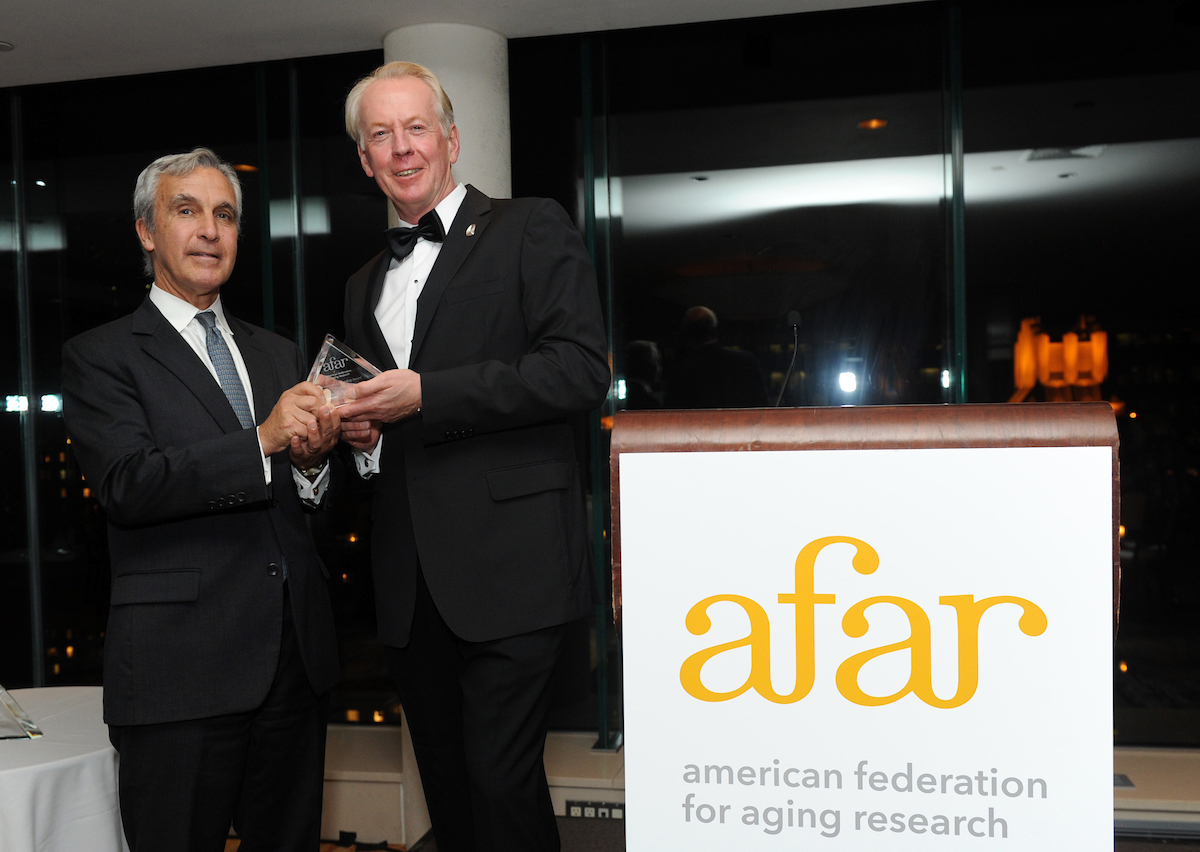
Nestlé Skin Health Honored by the American Federation for Aging Research

Nestlé Skin Health was honored with the 2016 Honorary Leadership Award from the American Federation for Aging Research (AFAR) for its Nestlé Skin Health SHIELD initiative (Skin Health Investigation, Education and Longevity Development) which aims to advance the future of skin health. AFAR is a U.S. nonprofit health, medical and scientific organization that supports healthy aging through biomedical research.Accepting the award on behalf of Nestlé Skin Health, Dr. Johannes J. Baensch, Chief Scientific Officer, said: “I am honored to receive this prestigious award from AFAR, to share it with a group of such distinguished honorees, and to do so in New York, home of one of the globally recognized leaders of the WHO Age-friendly Cities initiative. Nestlé Skin Health is committed to advancing research and innovation in aging, which we are undertaking through a global initiative led from our New York SHIELD Center. Together, Nestlé Skin Health SHIELD and AFAR are connecting innovators and thinkers from across disciplines to advance the science of aging and our understanding of how skin health, nutrition and even our microbiomes can affect the aging process.”

Along with the Corporate Leadership Award from the American Skin Association and the inclusion of skin health in the World Health Organization’s new Health and Ageing Strategy, this latest honor from AFAR caps off a year in which leading experts and institutions are increasingly recognizing the important role of skin health in supporting healthy and active aging: maintaining functional ability as we age.

“With more and more of us living to the age of 100 and beyond, protecting our skin health at every age is an important means of ensuring that our older years are happy, healthy and active ones. Our unwavering commitment to the people we serve is to enable them to start healthy, and stay healthy”, said Johannes Baensch.

About Nestlé Skin Health SHIELD

Nestlé Skin Health’s mission is to enhance quality of life by delivering science-based solutions for the health of skin, hair and nails. Nestlé Skin Health SHIELD (Skin Health Investigation, Education and Longevity Development) is a global network for innovation and education that gathers today’s most creative and visionary thinkers from diverse disciplines to generate, develop and incubate ideas to advance skin health and wellbeing. Ideas generated from SHIELD may result in new technologies, treatments, publications, white papers, educational approaches, or public policy briefing documents.

More information about SHIELD

Latest Developments

We keep our members and partners in touch with the most recent updates and opinions in the worldwide dialogue on population longevity and related issues.

GCOA Sign-on Letter to Governor Spanberger: Consequences of Importing Federal Price Caps on Virginians’ Access to Medicine & Healthy Aging Opportunities

Dear Governor Spanberger: We, the undersigned organizations, bring deep, on‑the‑ground experience serving older Americans, patients managing complex and chronic conditions, and their caregivers across Virginia and nationwide. We also have a clear understanding of which policies and programs are effective and where they fall short.

New Report Summarizes State of Expert Opinions on Japan’s Adult Vaccine Policy as Population Shifts Older

The Global Coalition on Aging (GCOA), Health and Global Policy Institute (HGPI), and the Asia-Pacific Consortium for Healthy Aging and Adult Immunization (AP-CHAAI) today announced the launch of Strengthening Vaccine Policy for Healthy Aging and Economic Growth in Japan, a landscape analysis examining the state of vaccine policy in super-aging Japan. Based on a comprehensive review of over 100 policy documents, recommendations, reports, academic papers, and gray literature articles, the report, which was funded by GSK, summarizes the latest academic research and policy discourse around adult vaccines.

WSJ Letter to the Editor: How Flu Vaccine Policies Affect the Economy

Your editorial “Vinay Prasad’s Vaccine Kill Shot” (Review & Outlook, Feb. 12) points out that a recent decision by Mr. Prasad, the leader of the Food and Drug Administration’s vaccine division, will have negative consequences. Mr. Prasad’s decision to reject Moderna’s flu vaccine without even reviewing it is even worse than you describe. Denying us a new, innovative flu vaccine is horrible health policy. Innovation is at risk because, as Moderna’s CEO has said, if the largest market is off limits, investments won’t be made. But the decision will also have economic consequences. Investment in preventive health is critical as our population ages. In its April 2025 World Economic Outlook report, the International Monetary Fund dedicated an entire chapter to the need for healthier longevity as the global population ages.

Joe Biden’s ‘Cancer Moonshot’ May be Derailed by New Policies, Including His Own

For almost a decade, President Biden has championed a bold “cancer moonshot” — an initiative he first launched in 2016, revived early in his administration, and reiterated during this year’s State of the Union. It is a laudable goal, especially for an aging nation where cancer and chronic disease are on the rise. There’s just one problem: Recent federal and state policies are poised to derail the incredible progress made in oncology since 2016. A rash of policies now threatens to limit access and slow progress towards new breakthroughs.

Global Coalition on Aging, Leading G7 Government Officials, Call for Incentivized Antibiotic Innovation

The Global Coalition on Aging (GCOA), in partnership with the Japanese Pharmaceutical Manufacturer’s Association (JPMA), and public health leaders call on G7 governments to fund pull incentives and make “fair share” investments in antibiotic innovation to fight the global antimicrobial resistance (AMR) crisis. GCOA, JPMA, and health and government officials from the European Union, Italy, Japan, and United Kingdom recently convened to discuss how G7 countries must respond. GCOA today published a report detailing takeaways from the closed-door meeting, “The Role of G7 Governments in Global Efforts to Encourage Antimicrobial Development Through a Pull Incentive: Challenges and Collaboration.”

Kishida and Biden Face a Similar Demographic Crisis

Your front page story “Japan wrestles with age-old problem as population declines at record rate” (Report, April 13) and the letter in the same edition from Tim Hill, “A gently declining population is no reason to panic”, both describe what all societies face as they modernise in the 21st century.

2024 AMR Preparedness Index Progress Report Highlights Urgent Need For Global Action Against Antimicrobial Resistance

Today, the Global Coalition on Aging (GCOA) and the Infectious Diseases Society of America (IDSA) launched the 2024 AMR Preparedness Index Progress Report. Released in the lead up to the United Nations General Assembly 2024 High-level Meeting on Antimicrobial Resistance (AMR) this September, the 2024 Progress Report assesses how the eleven largest global economies have advanced on calls to action laid out in the 2021 AMR Preparedness Index.

New Global Analysis Across Five Cities Shows Inequities in Adult Immunization Uptake, Signaling Need to Redesign Local and National Policy Interventions

GSK, in collaboration with the Global Coalition on Aging (GCOA), announced a new report from the IQVIA Institute for Human Data Science (IQVIA Institute). The report, funded by GSK, explores the role of social and structural determinants of health in adult vaccine access and uptake across five global cities with strong data about their aging populations: Bangkok, Thailand; Brussels, Belgium; Chicago, US; Manchester, United Kingdom; and New York City, US.